Getting there, the day and what you see
Getting to the GEM: day guide
Where the museum is, how to reach it, how long the full-day tour runs, what to wear, and what you actually see inside, checked against official pages.
Check dates and availability ↗Quick answer
The Grand Egyptian Museum is at El Remayah Square on the Cairo-Alexandria Desert Road, near the Giza pyramids. Its own site gives driving directions to Gate 2 and says metro details are coming soon, so most visitors arrive by car, taxi or tour. The full-day tour linked here includes pickup and drop-off in Cairo or Giza and runs 7 to 8 hours. Dress modestly, carry a small bag, and book a timed entry slot in advance.
Inside the museum at a glance
| Stop | What to know |
|---|---|
| Obelisk | First piece you meet |
| Grand Hall | Ramesses II statue |
| Grand Stairs | Six floors, pyramid view |
| Tutankhamun halls | 5,398 objects, phone photos only |
| Khufu boats | One whole, one rebuilt live |
Where the museum is
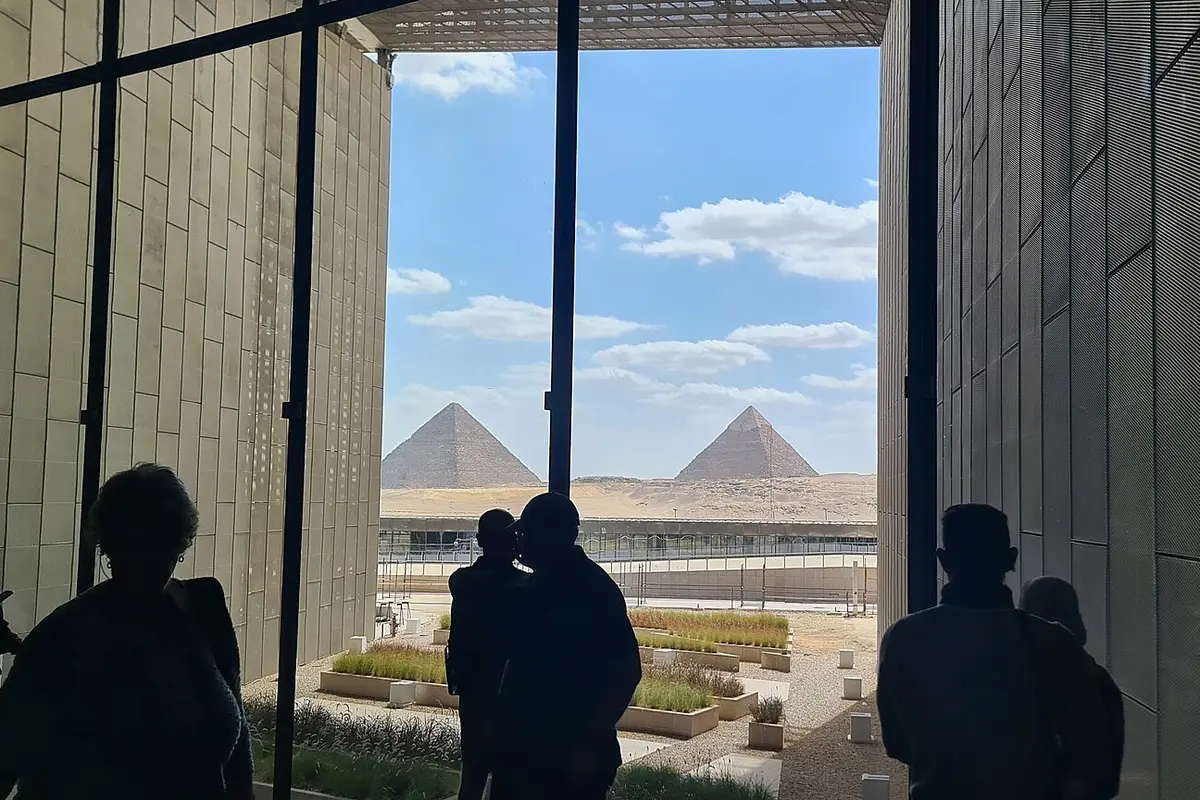
The museum stands at El Remayah Square on the Cairo-Alexandria Desert Road. It describes itself as part of the ancient site of Memphis and its necropolis, a World Heritage site near the Pyramids of Giza. It sits about 2 km from the Giza pyramid complex, and its north and south walls line up with the pyramids of Khufu and Menkaure. The complex covers about 500,000 square metres and holds an estimated 100,000 or more artefacts, so it helps to choose your priorities in advance. It is not the Egyptian Museum in Tahrir Square, which is a different building, so confirm the name with any driver before you set off.
Getting there and back
The museum's directions for drivers say to take the exit onto the Cairo-Alexandria Desert Road, head towards El Remayah Square and enter through Gate 2. The FAQ also gives separate directions for drivers coming from the 26th of July corridor and from east or west Cairo along the Ring Road. Its page for the metro reads "details coming soon", so no metro route is published, and its FAQ says updated public transport information will be available soon. Until that changes, plan on a car, a taxi or an organised tour. On-site parking is available for a fee and may be limited at peak times. With the full-day tour, pickup and drop-off at your accommodation are included.
A day on the full-day tour
The tour lasts 7 to 8 hours, and the booking calendar shows the starting time for your date. The day is set up with the pyramids and the Sphinx first and the museum afterwards, so ask your guide to confirm the running order. Pickup is from your accommodation in Cairo or Giza. Lunch at a local restaurant is included; drinks with it are not, and tips are not included either. Farther pickup areas are available as an add-on at checkout, and you should keep your passport or ID with you, although a copy is accepted. For comparison, the museum's own guided tour takes about two hours and covers the Tutankhamun Galleries, the Grand Hall, the Grand Stairs and the Main Galleries.
What you see at Giza
On the plateau, the tour covers the Great Pyramid of Khufu, the Great Sphinx and Khafre's Valley Temple, with a panoramic view of the three pyramids of Giza. The pyramids and the Sphinx date to the Fourth Dynasty, roughly 2600 to 2500 BC, and are part of a World Heritage site inscribed in 1979. The Great Pyramid is the only one of the Seven Wonders of the Ancient World still standing. Most Egyptologists agree that the Sphinx's head is that of Khafre. The tour's inclusions list entry to the pyramids-and-Sphinx area, but not going inside a pyramid, so ask before you assume.
Inside: the obelisk, the hall and the stairs
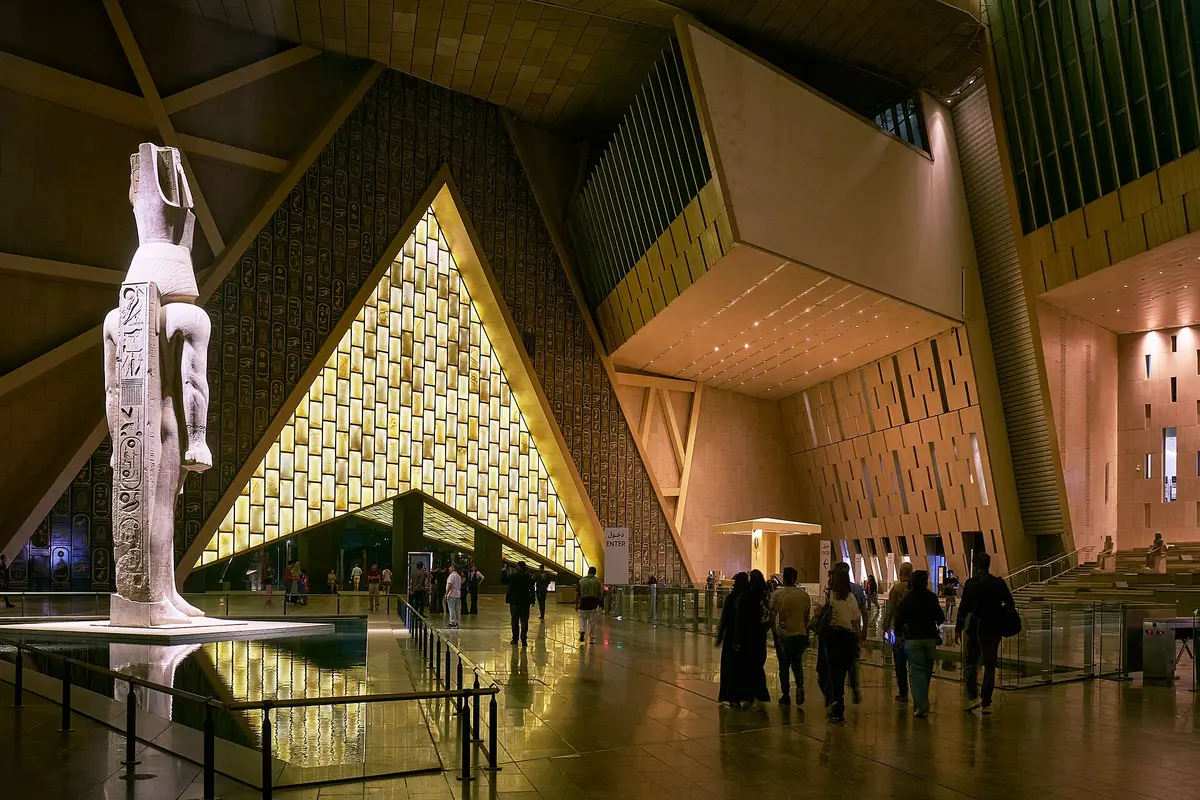
The first piece to greet visitors is the obelisk of Ramesses II, 16 metres tall and about 87 tons, which the museum has raised on a platform so you can see the cartouches carved on its underside. Inside, the Grand Hall holds an 11-metre statue of Ramesses II among 20 to 30 other large pieces. The statue was moved to the site in 2006 and placed in the hall in 2018. The Grand Stairs climb six floors past at least 60 artefacts, and at the top a view of the Giza pyramids opens out. They opened for trial visits in December 2023.
The Tutankhamun Galleries
Two Tutankhamun halls hold the 5,398 objects found in his tomb, the first time the whole collection is displayed in one place. The tomb's discovery began on 4 November 1922, and the last shipment of its contents was sent to Cairo in February 1932. The halls are designed to echo the original tomb, with environmental controls to protect fragile gold, wood and fabric. The gold mask is here: it is 39.3 cm wide, was found over the head and shoulders of the mummy, and has a protective spell inscribed on the back. Only mobile-phone photography is permitted in these galleries.
Read next: The Tutankhamun Galleries at the GEM
What you will not see: the king himself
Tutankhamun's mummy is not at the GEM. His mummy and sarcophagus remain in his tomb in the Valley of the Kings, and it is his burial goods that travelled to Giza, moving gradually from 2011 after decades at the Egyptian Museum in Cairo and the Luxor Museum. The museum was inaugurated on 1 November 2025 and opened to the general public on 4 November, the anniversary of the day the tomb's discovery began in 1922. Among the objects are a folding bed, the only intact example known from ancient Egypt, and 413 shabtis, small figures meant to do work for the king in the afterlife.
Khufu's boats
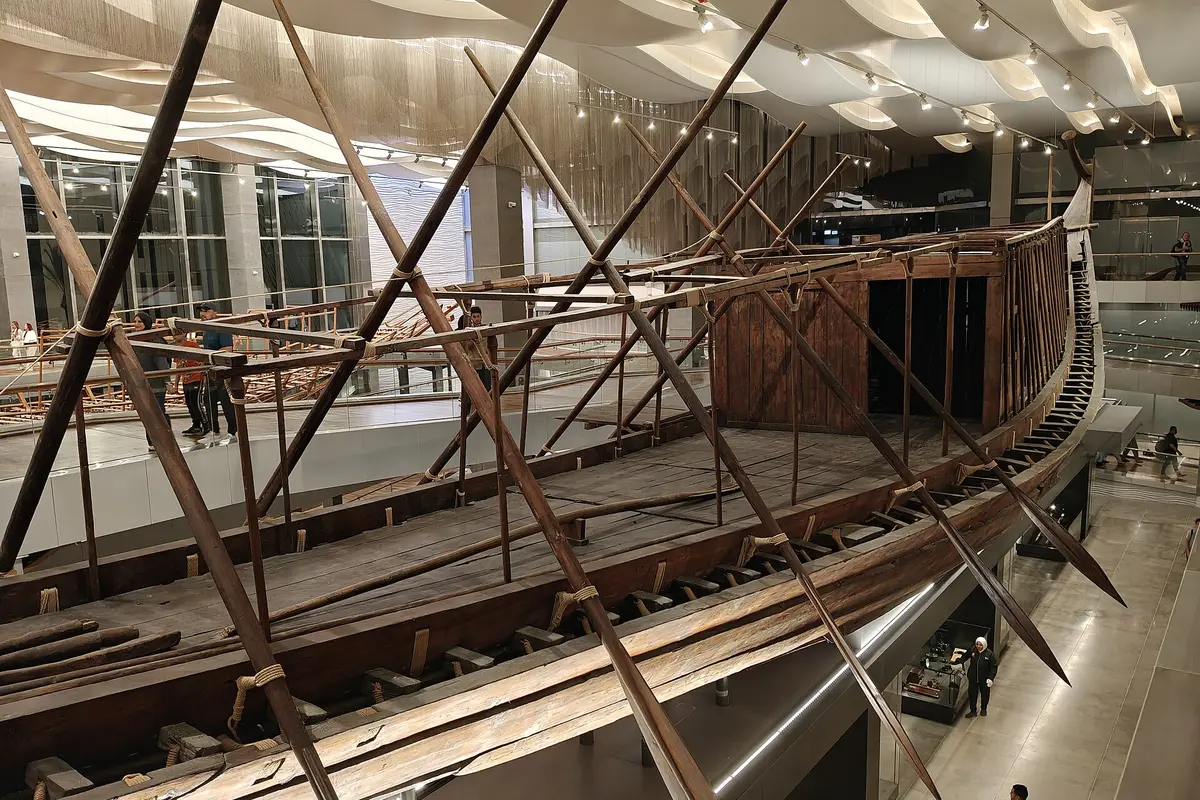
The Khufu Boats Museum holds the first of two boats found in 1954 beside the Great Pyramid. Built mainly of Lebanon cedar, it was reassembled from 1,224 pieces, measures 43.4 metres, and moved to the GEM in August 2021 after being displayed from 1982 in a museum beside the Great Pyramid. The second boat, of about 1,650 wooden pieces, is being reassembled in front of visitors, a project the museum expects to take several years. The Khufu Boats Museum is included in the official ticket.
Read next: Khufu's Solar Boats: Now Inside the GEM
Dress, bags and rules
The museum's terms ask for appropriate attire at all times. The Australian government's travel advice says dress standards in Egypt are very conservative, particularly for women, and recommends modest clothes that cover the legs and upper arms. Bags larger than 40 by 40 cm must go in the lockers, which are free; ask at the Information Desk. Small water bottles are allowed in the galleries, but other food and drink are not. Flash, tripods, selfie sticks and drones are banned, and umbrellas must be left in designated areas.
Children, access and language
Children under six are exempt from the admission fee, and children must be accompanied by an adult at all times. The museum has a Children's Museum aimed at ages 6 to 12. It lists ramps, lifts with audio announcements, wide pathways, wheelchairs, golf carts and a tactile replica with Braille, but the full-day tour is listed as not suitable for wheelchair users, so ask before booking. Live guiding on the tour is in French, English, German, Italian or Spanish; Dutch and Portuguese speakers should choose English. The museum's own audio guide is in Arabic, English and Japanese.
Who this isn't for
If you want a slow, museum-only day, the full-day tour will feel short on gallery time, because the pyramids and lunch share the same 7 to 8 hours. If you hope to see Tutankhamun's mummy, this is the wrong city: it stays in the Valley of the Kings. If you use a wheelchair, the tour as listed is not suitable. If you need a guide who speaks Dutch or Portuguese, the tour does not offer one. And if you hope to see everything, remember that the main galleries alone run from the Predynastic Period to the Roman period, so a first visit means choosing.
Frequently asked questions
Is there a metro to the GEM?
Not one the museum lists. Its page says metro details are coming soon, so no metro route is published. For now, travel by car, taxi or tour.
How long is the full-day tour?
It lasts 7 to 8 hours, covering the pyramids, the Sphinx, lunch and the museum. The booking calendar shows the starting time for your date.
Can I see Tutankhamun's mummy at the GEM?
No. His mummy and sarcophagus remain in his tomb in the Valley of the Kings. The GEM shows the 5,398 objects from the tomb, including the gold mask.
What should I wear?
Dress modestly. The museum requires appropriate attire, and Australian government advice recommends clothes that cover legs and upper arms. Bags over 40 by 40 cm go in the free lockers.
Is the tour suitable for wheelchair users?
The tour is listed as not suitable for wheelchair users. The museum itself has ramps, lifts, wheelchairs and golf carts, so a museum-only visit may suit better.
Can I take photos?
Yes, for personal use. In the Tutankhamun Galleries only mobile-phone photography is allowed. Flash, tripods, monopods, selfie sticks and drones are banned throughout the museum.
Sources
- FAQs (Grand Egyptian Museum)
- Obelisk of King Ramesses II (Grand Egyptian Museum)
- The Golden Burial Mask of Tutankhamun (Grand Egyptian Museum)
- Ancient Egyptian pharaoh's boat is being reassembled in public (Associated Press)
- Egypt travel advice (Australian Government, Smartraveller)
- Grand Egyptian Museum (Wikipedia)
- Tomb of Tutankhamun (Wikipedia)
- Khufu ship (Wikipedia)